

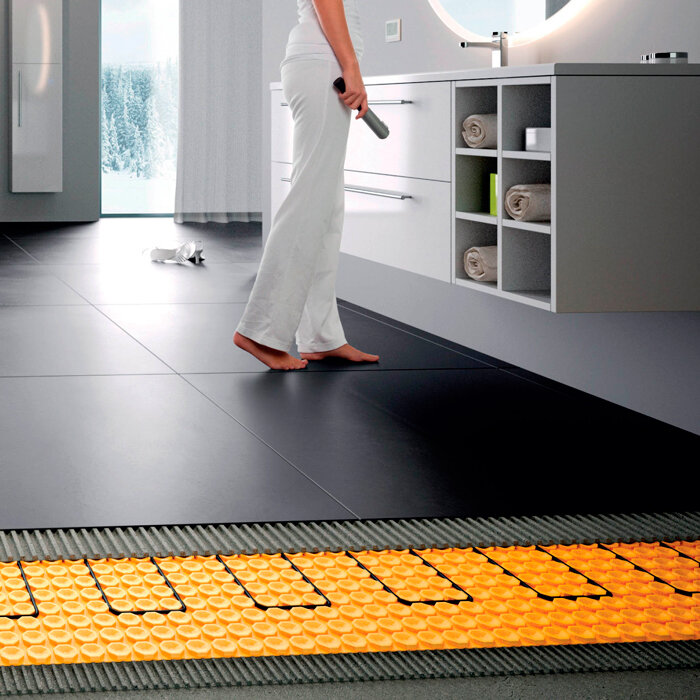
You wake up on a January morning in Fernandina Beach. The thermostat reads 38 degrees. You swing your feet onto the bathroom floor — and brace for the shock. It's a minor but memorable discomfort, and one that surprises people who assume Florida never gets cold. Radiant floor heating flips that experience entirely, delivering warmth that rises gently from the surface beneath you. But does it belong in a coastal Southern home? And more importantly — which flooring materials actually work with it?
Why Tile Excels with Radiant Heating
If you're installing radiant heat, tile is your strongest ally. Ceramic and porcelain are dense, thermally conductive materials that absorb warmth efficiently and radiate it back into the room long after the system cycles off. Unlike some surfaces that insulate against the very heat you're trying to transmit, tile welcomes it.
That pairing matters particularly in bathrooms and kitchens, where bare feet meet cold surfaces every day. And in a climate defined by humidity and salt air, the mold and mildew resistance built into today's porcelain options adds another layer of practicality. You can browse ceramic, porcelain, and wood-look styles in our tile flooring catalog — the variety may surprise you, especially if you last looked at tile a decade ago.
Where Luxury Vinyl Fits In
Luxury vinyl brings a different set of trade-offs to the radiant heating conversation. Yes, LVP and LVT can work with underfloor systems — but with an important caveat: most manufacturers cap the surface temperature around 85°F. Exceed that threshold and you risk warping, seam separation, or voiding the warranty entirely.
That said, for homeowners who want the look of wood with radiant-compatible performance and don't want to push the thermostat high, vinyl holds its own. It's waterproof, handles sand and pet traffic without complaint, and installs faster than most alternatives. Our luxury vinyl collection includes LVP and LVT options worth comparing alongside tile if you're weighing both materials for a heated-floor project.
What Installation Actually Requires
Radiant heating isn't a weekend DIY pursuit — and the subfloor preparation makes or breaks the outcome. Whether you choose electric mats (more common in retrofits) or hydronic tubing (typical in new construction), the substrate must be level, clean, and properly insulated. Skipping the insulation layer is the most common mistake: without it, much of your heat radiates downward into the slab or crawlspace instead of upward where you feel it.
This is where professional oversight pays for itself. Our licensed installation team has years of experience with underfloor heating systems paired with tile, and every project carries a lifetime warranty — meaning the work is guaranteed for as long as you own the home.
Is It Worth It? A Practical Take
Radiant floor heating in Northeast Florida is a luxury, not a necessity. But luxuries that eliminate cold-tile shock on a 40-degree morning, operate silently, and add measurable resale appeal tend to justify themselves over time. The systems are remarkably efficient when used for spot heating — warming the master bathroom floor rather than the entire house. And in a region where new construction is booming, including the communities rising around Yulee, radiant-ready bathrooms are becoming a differentiator.
The right flooring makes the difference between a system that performs beautifully and one that disappoints. When you're ready to explore what's possible — request a free estimate and we'll walk through your options together, starting with the floor you'll actually love standing on.


