

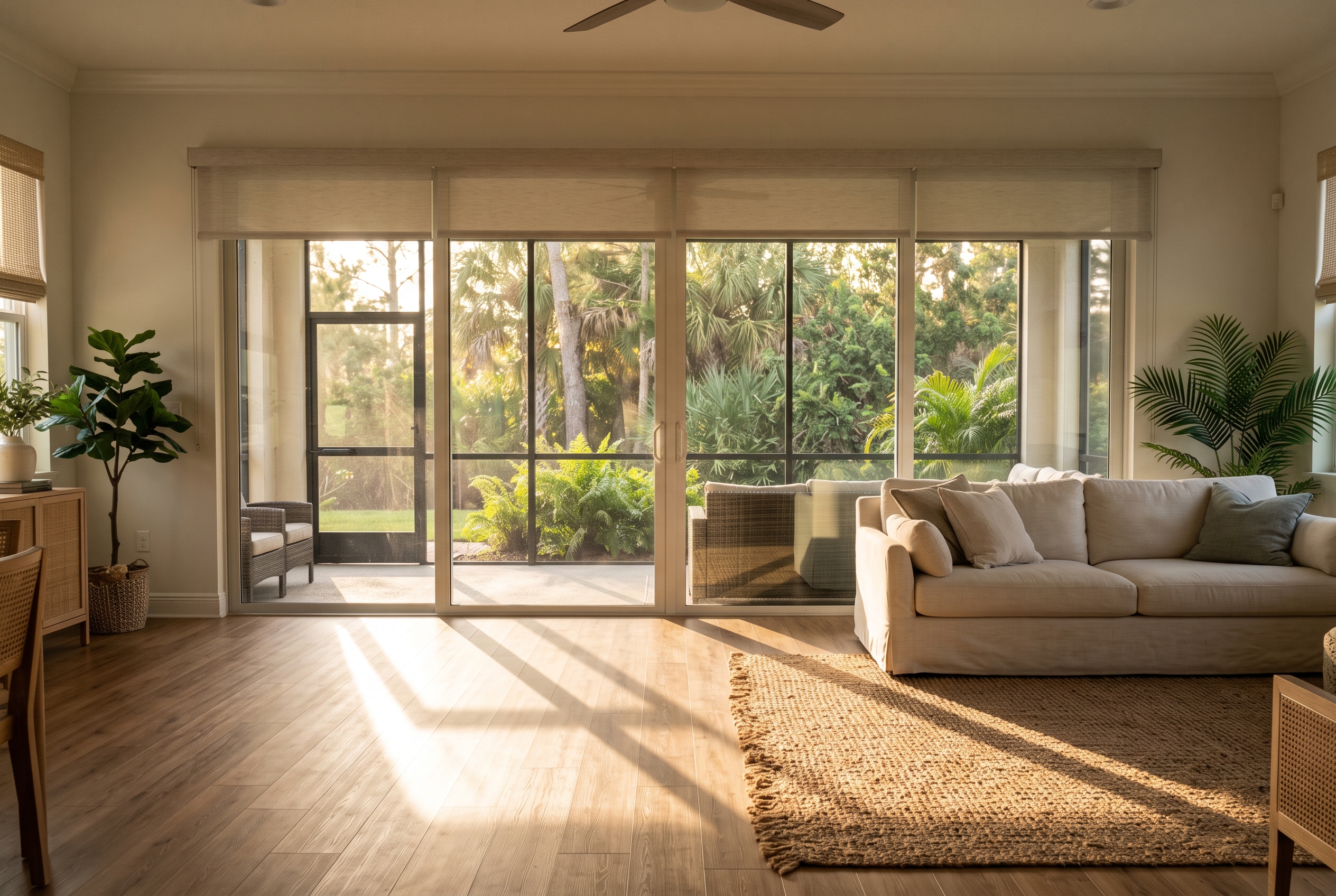
Every floor changes a little in strong sun, and the material decides how much. Wood changes the most, darkening or lightening by species. Vinyl plank fades slowly where direct sun lands every day, and in front of glass doors heat is the bigger risk. Laminate and solution-dyed carpet change very little, and porcelain tile not at all. The protection is the same for every floor: stop the UV at the glass, keep hard afternoon sun off the floor, and move rugs and furniture now and then.
Hardwood: expect a color change. Some species darken noticeably, others mellow, and rugs leave outlines because they shade the wood beneath them.
Vinyl plank: it holds its color well, but daily direct sun fades it slowly, and the heat at a sunny slider can make planks expand.
Laminate: it fades very little, because its picture layer sits under a hard, clear top layer made to hold its color.
Carpet: the dye method decides it. Solution-dyed fibers hold their color; others want window protection.
Tile: glazed porcelain and ceramic do not fade, which makes tile the floor for the sunniest spots.
| Floor | How much sun changes it | Watch at glass doors | Best defense |
|---|---|---|---|
| Hardwood | The most; varies by species | Rug and furniture outlines | UV film, shades, move rugs |
| Vinyl plank | Slowly, where sun hits daily | Heat expanding the planks | Shades at peak sun, film |
| Laminate | Very little | Heat at the glass | Shades at peak sun |
| Carpet | Depends on the dye method | Fading along the window line | Solution-dyed fiber, shades |
| Porcelain, ceramic tile | None | Nothing | None needed |
Why Sunlight Changes the Color of a Floor
Sunlight changes a floor's color mainly through ultraviolet light, which breaks down the colors in dyes and prints and the natural compounds in wood. Ordinary window glass stops some of it, not all: the Skin Cancer Foundation notes that glass filters out most UVB, while UVA passes through windows year-round. Visible light keeps working on wood even after the UV is gone. Heat is a separate effect, and it moves floors rather than fading them.
Here the sun is strong most of the year, and its angle matters as much as its strength. On summer evenings the low western sun comes straight through west-facing sliders and lands deep on the floor. In winter the low southern sun reaches far into south-facing rooms that are shaded in July. A covered lanai or a deep roof overhang shades the glass for much of the day, which is why two rooms with the same floor can age very differently.
Does Sunlight Fade Hardwood Floors?
Yes, sunlight changes the color of every hardwood floor, and the species decides which way. The wood flooring industry calls some species photosensitive, meaning they lighten or darken when exposed to light. Cherry darkens, and Brazilian cherry deepens from salmon toward a russet brown as it seasons. Many tropical woods darken too, while oak and hickory change more quietly.
You usually notice it first in two places: the strip of floor in front of a sunny window or slider, and the sharp edge where a rug or a piece of furniture has been sitting. Engineered wood changes the same way as solid wood, because its top layer is real wood. A stained floor changes too, since the wood under the stain still reacts to light.
Color change is not the same as wear, and it helps to tell them apart. Color change is even across everything the light reaches, with a crisp line where the shade begins. Wear shows up in the paths people walk, as a duller, scuffed or grayish finish.
Color change leaves nothing to repair, while wear means the finish needs attention. For the care routines that keep a wood floor looking its best near the coast, see our post on caring for hardwood floors in coastal homes.
What to do about it depends on how much you mind. If you like the way a wood floor warms with age, simply keep the light even by moving rugs and furniture now and then. If you want to slow the change, start with the glass that gets the most sun, using film or shades.
Rug Outlines and Furniture Shadows
A rug outline or a furniture shadow on a wood floor means the floor around it changed color in the light while the floor underneath did not. The wood flooring industry's own guidelines warn that area rugs shield the floor from sun and cause these color differences. The same thing happens under a sofa, a bed or a dresser that sits in one place for years.
On wood, the fix is time and even light. Take the rug up, or shift it so the outlined area is exposed, and the shaded wood catches up over the following months as it gets the same light as the rest of the floor. Sanding removes the changed surface, but the fresh wood underneath starts changing again, so sanding only to fix an outline rarely makes sense.
Choose rug pads with the same care. Some nonskid pads press their pattern into a wood finish, so use a pad made for wood floors. On vinyl plank, never use rubber-, latex- or coco-backed mats, which can stain the surface.
Does Sunlight Fade Luxury Vinyl Plank?
Yes, slowly, where direct sun lands on it every day. Luxury vinyl plank gets its look from a printed layer under a clear wear layer, and today's planks are made to hold their color well. Mannington's care guidance still asks owners to close curtains or blinds where extreme sunlight hits the floor, because the combination of heat and sun can fade, discolor or expand most home furnishings, vinyl included.
Faded color in a vinyl plank does not come back. If one sunny strip by the door has faded, the fix is to replace those planks with spares from the same run, which is one reason to keep a carton after the job.
Heat at Sliding Glass Doors and Big Windows
In front of a sunny slider, heat is a bigger risk to a floating floor than fading. The sun through a big pane heats the planks in front of it far more than the rest of the room, so they expand more than their neighbors. A floating floor can open small gaps when it cools, or peak and lift when it cannot expand any further. The instructions for one of the vinyl floors we carry set an upper limit of 140 F, and a floor in hard afternoon sun behind glass can get surprisingly hot.
The fixes are straightforward:
- Close shades or blinds over the glass for the hours the sun lands on the floor.
- Keep the house air-conditioned, even when you are away.
- Make sure the floor's expansion gap at the door threshold is clear, with no trim or caulk pinning it.
- In a room that is nearly all glass, ask about a floor and an installation suited to it, since some floors have special rules for rooms that get very hot.
Does Sunlight Fade Laminate Floors?
Yes, but very little. Laminate's wood or stone look is a printed layer sealed under a hard, clear top layer, and the laminate we sell is resistant to both staining and fading. The strip in front of a sunny slider can still warm up and move like any floating floor, so the heat advice for vinyl plank applies to laminate too. Our laminate flooring page covers its other benefits.
Does Carpet Fade in the Sun?
It depends on how the color got into the fiber. Solution-dyed fibers have their color added before the fiber is spun, so the color runs all the way through. Mohawk describes its solution-dyed fiber as having the color built right in, so it will not wear off or fade. Carpets dyed after the fiber is made, and natural fibers such as wool, are more sensitive to strong sun and do best with window protection.
For a bedroom or living room with big west or south windows, ask for a solution-dyed carpet. Our carpet guide covers fibers and styles if you are still choosing.
Does Sunlight Fade Tile?
No, glazed porcelain and ceramic tile do not fade. Their color is fired into the glaze, which is why tile is the floor for the spots where the sun hits hardest, from a breakfast nook to a room that opens onto the pool. Grout can lighten over many years, and natural stone is a different material that can change, but porcelain and ceramic hold their color. Our tile flooring guide explains porcelain and ceramic.
How to Protect Floors From Sun Damage
To protect floors from sun damage, stop the light before it reaches the floor: UV-blocking window film or low-E glass first, then shades, then moving what sits on the floor. These are the steps, from the ones that stop the most to the ones that only even things out:
- Add UV-blocking window film to the worst glass. The window film industry's association says quality films block 99 percent of UV, and it represents the companies that sell them. Film does not stop visible light, which still changes wood, so it slows fading rather than ending it.
- Choose low-E glass when you replace windows or doors. The Department of Energy says low-E glass reflects UV away from the house and can cut UV-induced fading of furnishings by as much as 75 percent, and it reduces heat too.
- Close shades and blinds for the hours the sun reaches the floor. Exterior shade works better still, because a lanai roof, an awning or a screen shades the glass before the heat gets in.
- Move rugs and furniture a few times a year, so the whole floor ages together, and use rug pads made for your floor.
- Keep the house conditioned when you are away, so a closed-up room does not bake.
- Choose a floor that holds its color for the sunniest rooms.
| Protection | What it stops | Best for |
|---|---|---|
| UV window film | Most UV; not visible light | Any glass the sun hits |
| Low-E glass | Much UV and heat | New windows and doors |
| Shades, blinds, lanai roof | Light and heat when closed | Peak sun hours |
| Moving rugs and furniture | Outlines | Wood floors |
| A colorfast floor | Fading at the source | New floors in sunny rooms |
If you add film, a clear UV film keeps the view and still blocks most UV, while a tinted film also cuts glare and heat. Compare films by their UV rejection figure, and start with the glass the sun actually reaches. No film or glass stops the change completely, because visible light still reaches the floor, so pair the glass with shades at the sunniest hours.
When a New Board Does Not Match the Old Floor
A new board from a spare box often looks fresh against a floor that has spent years in the light. The spare stayed the color it was made, while the floor slowly changed. On wood, the new board catches up as it gets the same light, so give it time before you judge it. On vinyl plank or laminate the difference is usually small, since both hold their color well.
To narrow the gap, pull a replacement board from a closet, where the floor is the same age but shaded, and use the fresh spare in the closet instead. Store spares indoors and out of the sun, so they stay as close as possible to the floor they will join.
Choosing a Floor for a Room That Gets Strong Sun
The most fade-resistant floor for a room that takes hard sun is porcelain tile, and after that it comes down to how much change you will accept. Laminate and vinyl plank do well with shades on the glass at peak hours, and lighter or mid-tone colors show any fading less than very dark ones. Wood works if you choose a species whose color change you like. In carpet, solution-dyed fiber is the choice.
When you shop, ask for these:
- For carpet, a solution-dyed fiber.
- For vinyl plank or laminate, what the care guide says about direct sun, and the floor's temperature limit if the room has walls of glass.
- For wood, how the species changes with light, and a sample that has aged so you can see where it is heading.
- For tile, porcelain or glazed ceramic rather than natural stone where the sun lands.
The best test is your own light. Take samples home, set them where the sun lands at its strongest hour, and look again in the morning and the evening. A Florida room or an enclosed porch brings humidity into the choice as well as sun, so weigh both. If wood is on your list, our hardwood collection shows the species and colors we carry.
Seeing Floors in Your Own Light With Us
At American Flooring in Yulee, the surest way to judge a floor for a sunny room is to borrow samples from our showroom and watch them through a full day of your own light. Our professionally trained design team can help you weigh a sunny room's choices across every category we carry. When you are ready, we take careful measurements and plan the project with you, and our installation team handles every floor we sell. If you are installing it yourself, our DIY Discount applies to everything we sell.
Questions People Ask About Sun and Floors
Should You Wait Before Putting Rugs on New Hardwood?
Yes, on a wood floor finished on site, wait at least seven days after the last coat of finish before laying rugs, unless the finish maker says otherwise; the wood flooring industry's guidelines set that minimum. On any wood floor, move the rugs now and then so the floor ages evenly.
Does Sun Through a Screened Lanai Still Fade Floors?
Yes, though less. A screened lanai shades the glass behind it and cuts some of the sun, but low morning and evening sun still reaches the floor through the glass, so treat the room as a sunny one.
Can Faded Vinyl Plank Be Fixed?
No, faded vinyl plank cannot be restored, because the color is printed into the plank. The faded planks are replaced instead, and spares from the same run make the repair match.
Do Floors Fade in a Closed-Up Second Home?
Yes, the sun works whether anyone is home. Close the blinds on the sunny sides before you leave, and keep the air conditioning set so the rooms do not overheat, which protects floating floors from heat as well as fading.
Choosing a floor for a bright room, or wondering about one that is already changing color? Request a free estimate, and we will help you match the floor to the light.


